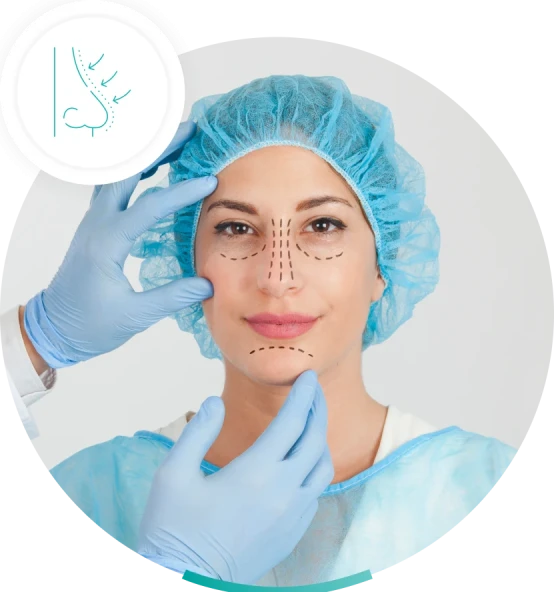
Currently very popular, rhinoplasty aims to achieve facial harmony by improving the appearance and proportion of the nose in relation to the face.
Nose surgery is indicated for several situations, such as: an overly large nose, lack of proportion, drooping nasal tip due to aging, prominent nasal bone, excessively wide nostrils, or an overly thick nose.
In addition, rhinoplasty may also be recommended to address chronic breathing problems.
Rhinoplasty can be performed on adult men and women, as well as on adolescents around 15 years of age — or once facial development is complete.
As the nose is the central feature of the face, rhinoplasty can represent a significant transformation. It is common for patients to expect to look like a famous person, but this is not a realistic expectation, as every individual and every body is unique. It is essential that the patient’s natural facial features serve as the foundation for the surgery and are respected, so their identity is preserved.

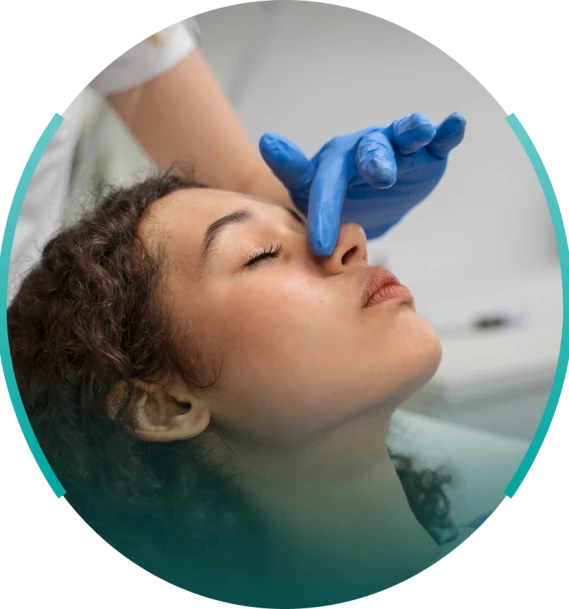
The procedure can reduce, increase, and reshape the bone and cartilage structures of the nose.
There are two surgical techniques: open and closed.
Closed Technique
In the closed technique, the incisions are made inside each nostril, and through them the surgeon performs the procedure. The main advantage of this technique is slightly faster healing, as there are no external incisions.
Open Technique
The open technique involves a small incision in the columella, just below the tip of the nose. With this approach, the surgeon lifts the nasal skin to gain direct visual access to the underlying structures.
Although different, both techniques are effective and provide excellent results. The plastic surgeon determines which technique to use based on what is most appropriate for the patient’s anatomy.

After nose surgery, a special rigid plastic splint is applied to keep the nasal structures properly positioned. This dressing should only be removed at the appropriate time, following medical guidance.

In the first few days, due to swelling, it is common to experience some difficulty breathing. Bruising may also occur and typically fades within the first few weeks.

Patients are advised to sleep with their head elevated during the first weeks, as this helps improve breathing. To avoid accidental impact, it is important to avoid sleeping on the stomach or on the sides.

Recovery varies from patient to patient, but returning to work usually occurs within one week.

Initial results begin to appear in the first month, as swelling and bruising subside. Final results become evident over the following months, once healing is complete.
The duration of the surgery varies according to each case, but it generally lasts between one and two hours. After evaluating the patient, the surgeon may choose local anesthesia with sedation or general anesthesia.
Both techniques allow, when necessary, treatment of the nasal alar region. In such cases, the incisions—one on each side—are discreetly hidden within the natural nasal crease.

Olá! Preencha os campos abaixo para iniciar a conversa no WhatsApp